- Treat a proxy flag as evidence about the connection. Check account or payment history for evidence about the action.
- Hold the benefit or delivery when review is needed and give the customer a way to continue.
- Compare the cost of reviews and abandoned orders with independently confirmed losses.
On this page
A buyer comes back to reorder supplies, signs in with a passkey and ships to the same address as last month. The IP lookup says “proxy.” Five minutes later, a new account on the same network claims a welcome credit that your records show was already redeemed. Let the buyer place the order. Refuse the duplicate credit. The network label is identical. The evidence about the two transactions is different.
That distinction makes proxy detection useful at signup and checkout. A proxy flag tells you something about the route a request took. Your application knows which benefit, account or payment is at stake. Make the decision where those two pieces of information meet.
When to allow, review or block a proxy visit
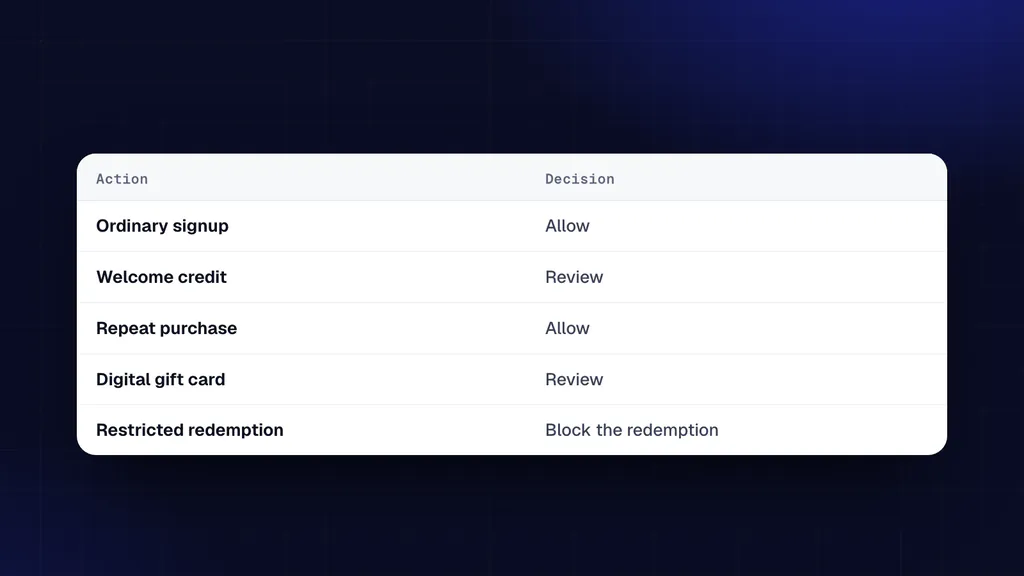
| Action | Evidence | Decision | What the customer experiences |
|---|---|---|---|
| Ordinary signup | Corporate VPN, first attempt, no conflicting evidence | Allow | Complete the usual email verification. |
| Welcome credit | Proxy and a burst of claims tied to the same referral or verified account | Review | Create the account and hold the credit while eligibility is checked. |
| Repeat purchase | Privacy relay, established account, familiar delivery details | Allow | Continue through ordinary payment authorization. |
| Digital gift card | New account, proxy signal and unrelated payment failures on the same cart | Review | Request payment authentication or hold delivery for review. |
| Restricted redemption | Server records confirm this account already used a one-use benefit | Block the redemption | Explain that the offer was already used. Other account features stay available. |
Try the VPN review example to inspect the decision and its reason codes.
Give “review” a concrete meaning. An email challenge works for a signup if proving control of the mailbox answers your question. It tells you little about ownership of a payment card. For a paid order that needs investigation, record a fulfillment hold before the code, download or shipment is released. Stripe documents that a payment in its review queue may already have been processed. Stripe’s review guide.
Try it on your own forms
One call before signup, login or checkout returns allow, review or block; the Free plan includes 10,000 visitor checks a month with no card, and setup starts in watch mode, which logs every decision and blocks no one until you turn blocking on.
Read the IP evidence without counting it twice
Apple’s iCloud Private Relay uses an egress IP that multiple subscribers can share. Apple publishes its egress ranges so websites can recognize that traffic and warns that conventional IP rate limits can affect unrelated people. On a mobile carrier, address sharing can produce a similar cluster of ordinary customers. Ten signups from one exit warrant a look at the signups. They do not establish that one person created ten accounts. Apple’s Private Relay guidance and the IETF’s analysis of shared IPv4 addresses.
A residential IP can also be a commercial proxy exit. MaxMind describes its residential proxy field as an indicator of a suspected anonymizing network. Read the meaning of your provider’s field before writing a rule around it. An “anonymous network” flag and a “proxy” flag from the same database may describe the same observation. Counting both as independent votes can turn weak evidence into an automatic rejection. MaxMind’s anonymous IP field definitions.
Look for another fact with a different source. Your redemption ledger can confirm whether a benefit is available. Your payment provider can tell you the result of authentication. A browser check can supply context about the current visit. Keep the distinction between a missing check, a completed check with no flags and a completed check with a match. Those cases need different explanations when a customer contacts support.
Put the decision next to the action it protects
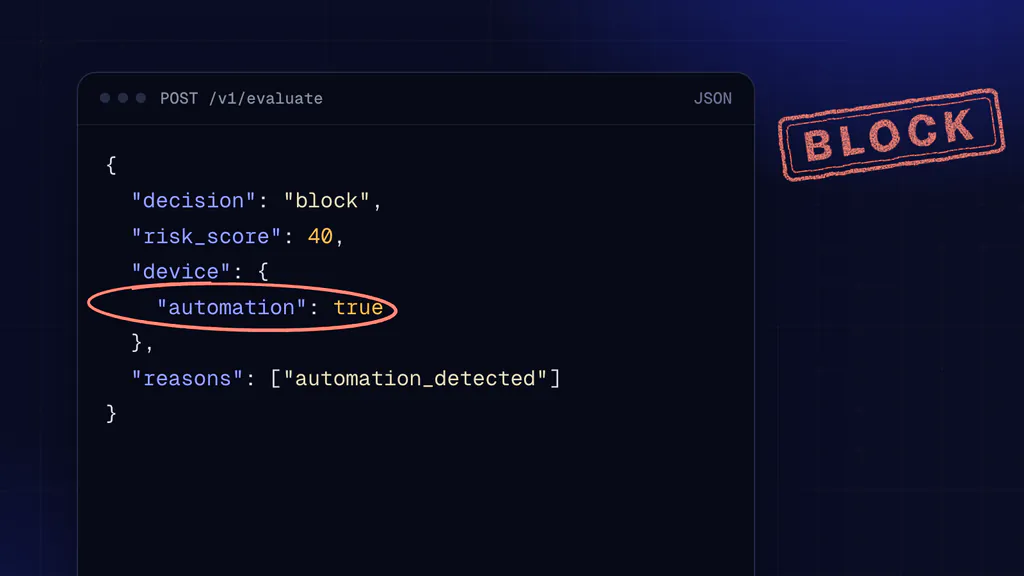
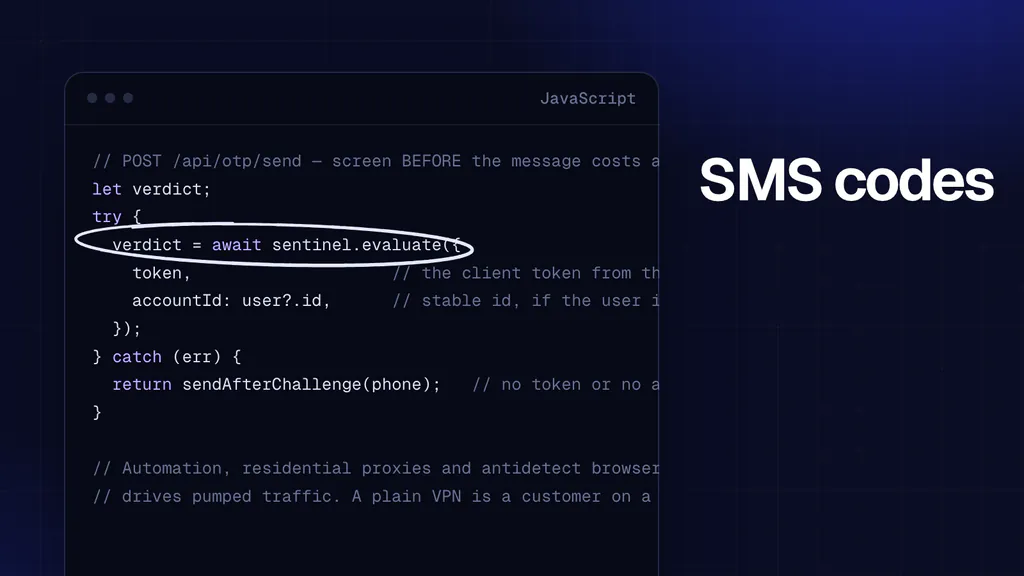
For a Maskbreak integration, the browser supplies a visit token. Your server sends it to POST /v1/evaluate and reads the decision, the network fields and the named reasons. Use the result in the handler that creates the account, grants the credit or releases the order. A block page tells the customer what happened. The server has to stop the protected action, including when the form is retried. Maskbreak’s evaluate API.
For example, give the order one durable ID and record its review state against that ID. When a payment callback arrives, the fulfillment job checks that state before sending a gift card. If the risk check times out, a low-value reorder can follow your existing payment checks. An instantly redeemable high-value order can wait for a decision. The buyer should see whether they need to do anything and whether another charge will occur if they retry.
Measure what the extra check buys you
Suppose a checkout team reviews 200 proxy-labelled orders in a pilot. Each review costs $2. Five legitimate customers abandon the extra step, at $30 of lost contribution margin each. The estimated cost is $550. If each genuinely prevented fraud loss would be $75, the policy needs to prevent at least eight such losses to cover that cost. These are illustrative inputs. Replace them with your own review cost, margins and loss estimates. A count of orders held cannot tell you how many losses you prevented.
Start in observation mode. Record the proposed action, the checkout or signup ID, the rule version and the eventual outcome. Compare a sample of allowed cases as well as cases sent to review. Give disputes time to arrive. Break results out by privacy relay, corporate VPN, mobile network and unknown network, and by the action you protected. A policy that pays for itself on instant gift cards may lose money on repeat grocery orders.
Use the smallest rule whose results you can explain. “This welcome credit was already redeemed” helps a customer and a reviewer resolve a case. “Your IP is suspicious” leaves both of them looking for the evidence. For the network checks you can run before changing a policy, see the guide to live proxy detection and IP lookups.
Questions people ask
- Should I block every proxy IP at signup?
- An ordinary signup through a shared office VPN or privacy relay can proceed through your usual verification. If a valuable benefit is at stake, check eligibility and confirmed abuse history before granting it.
- What does review mean at checkout?
- Choose a specific action, such as requesting payment authentication or holding fulfillment while an order is checked. A payment in review can already have been processed, so the fulfillment system needs to honor the hold.
Put the check where the attack enters
One call before signup, login or checkout returns decision, risk_score and the reasons behind them. The Free plan includes 10,000 visitor checks a month with no card, and setup starts in watch mode, so nothing is blocked until you turn blocking on.